
The Weirdest Things Ever Sent by Mail
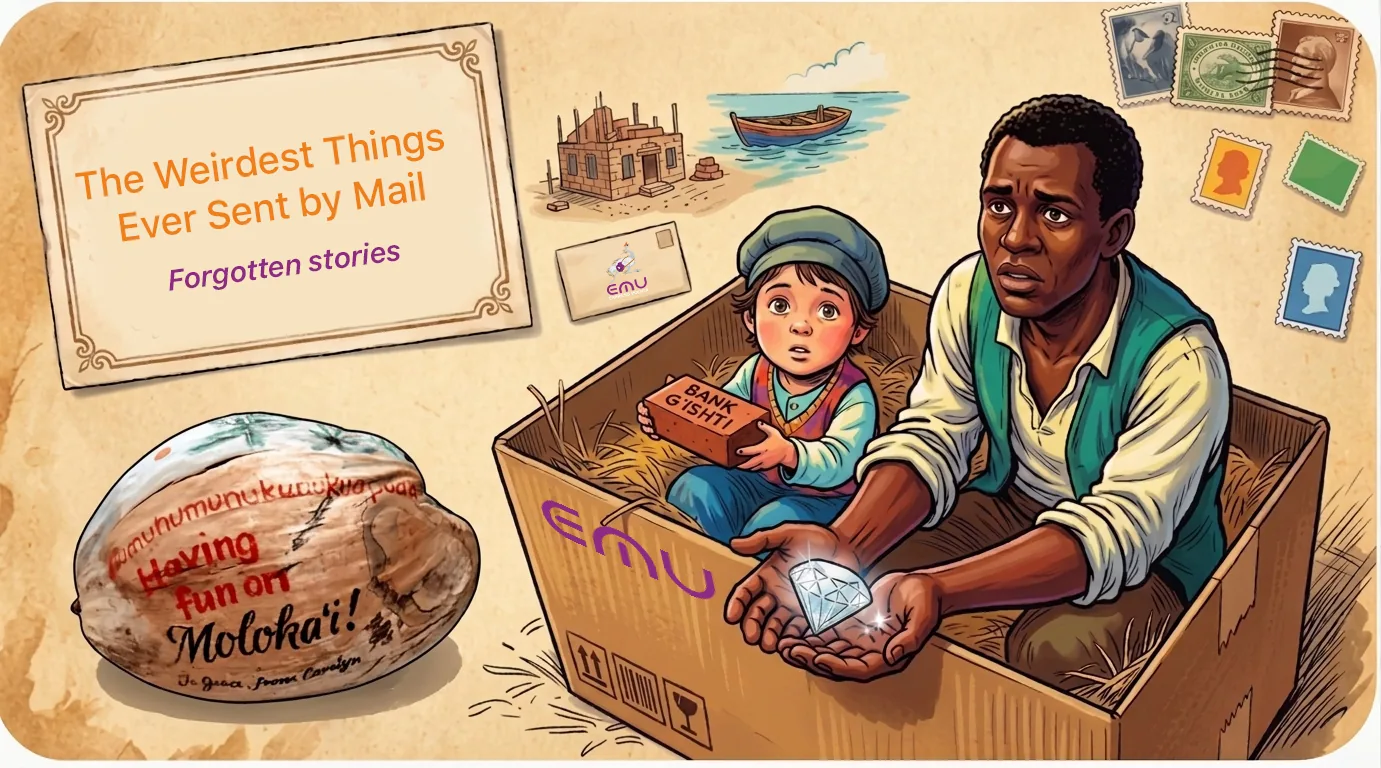
When we think of mail, most of us picture letters, postcards or clothes ordered from an online store. But postal history is far more interesting than we imagine: people have mailed children, diamonds, the bricks for an entire building, and even themselves. Here are some of the strangest parcels ever sent: 2. Children Sent by Mail When the United States launched parcel post service in 1913, allowing packages of up to 50 pounds (about 22 kg), some parents read the rules their own way. A train ticket was expensive and postage stamps were much cheaper, so they came up with the idea of mailing their children. The most famous case happened in Idaho in 1914. Five-year-old Charlotte May Pierstorff had 53 cents' worth of stamps attached to her coat and was mailed to her grandmother's house. She rode the whole way in the mail car, watched over by a relative who worked as a postal clerk. Officials soon banned such "shipments", yet similar cases kept turning up for a few more years. 2. The Man Who Mailed Himself to Freedom In 1849, Henry Brown, a man enslaved in Virginia, made a dangerous but courageous decision. He sealed himself inside a small wooden crate and had it shipped as freight via the Adams Express Company to Philadelphia, Pennsylvania, where slavery had been abolished. The journey took a full 27 hours. At times the crate was carried upside down, but Brown stayed silent the whole way. When the box was opened at its destination, he climbed out safe and sound. He went down in history as Henry "Box" Brown and became one of the best-known symbols of the anti-slavery movement. 3. The Bank Built by Mail In 1916, a new bank building was going up in Vernal, Utah, but hauling the bricks with ordinary freight companies was far too expensive. So a businessman came up with a clever and unexpected solution: he split the bricks into small 50-pound parcels and sent them by mail. Tens of thousands of bricks arrived by post, and the building rose brick by mailed brick. Soon afterwards, the postal service quickly limited how much one sender could mail in a single day. The Bank of Vernal is still known today as "the bank that was sent through the mail." 4. A World-Famous Diamond in a Plain Wrapper In 1958, jeweler Harry Winston donated one of the world's most famous gems, the Hope Diamond, to the Smithsonian Institution. Surprisingly, he didn't send this priceless treasure with armed guards or in an armored car. He mailed it as an ordinary registered package wrapped in plain brown paper. Winston paid just $2.44 in postage, while the package itself was insured for $1 million. The diamond arrived without a hitch, and today you can see it at a museum in Washington, D.C. The simple paper wrapper it traveled in is now preserved as a unique exhibit at the National Postal Museum. 5. A Coconut from Hawaii The Hoolehua post office on the Hawaiian island of Molokai has a wonderful tradition. Visitors and locals skip the box entirely and write an address and a greeting with a marker straight onto a coconut. Then they add stamps and send it anywhere in the world. Thousands of coconuts leave this post office every year, making it perhaps the most tropical and creative postcard there is. Conclusion: Mail Is More Than Letters These stories show just how inventive, and sometimes overly resourceful, people can be. Many of the postal rules and restrictions we follow today exist precisely because of strange and unexpected cases like these. Mailing children was banned, the volume of parcels (like bricks) was limited, and that is how the postal system got its modern rules.