
History of Mail: From Persian Couriers to Electronic Letters
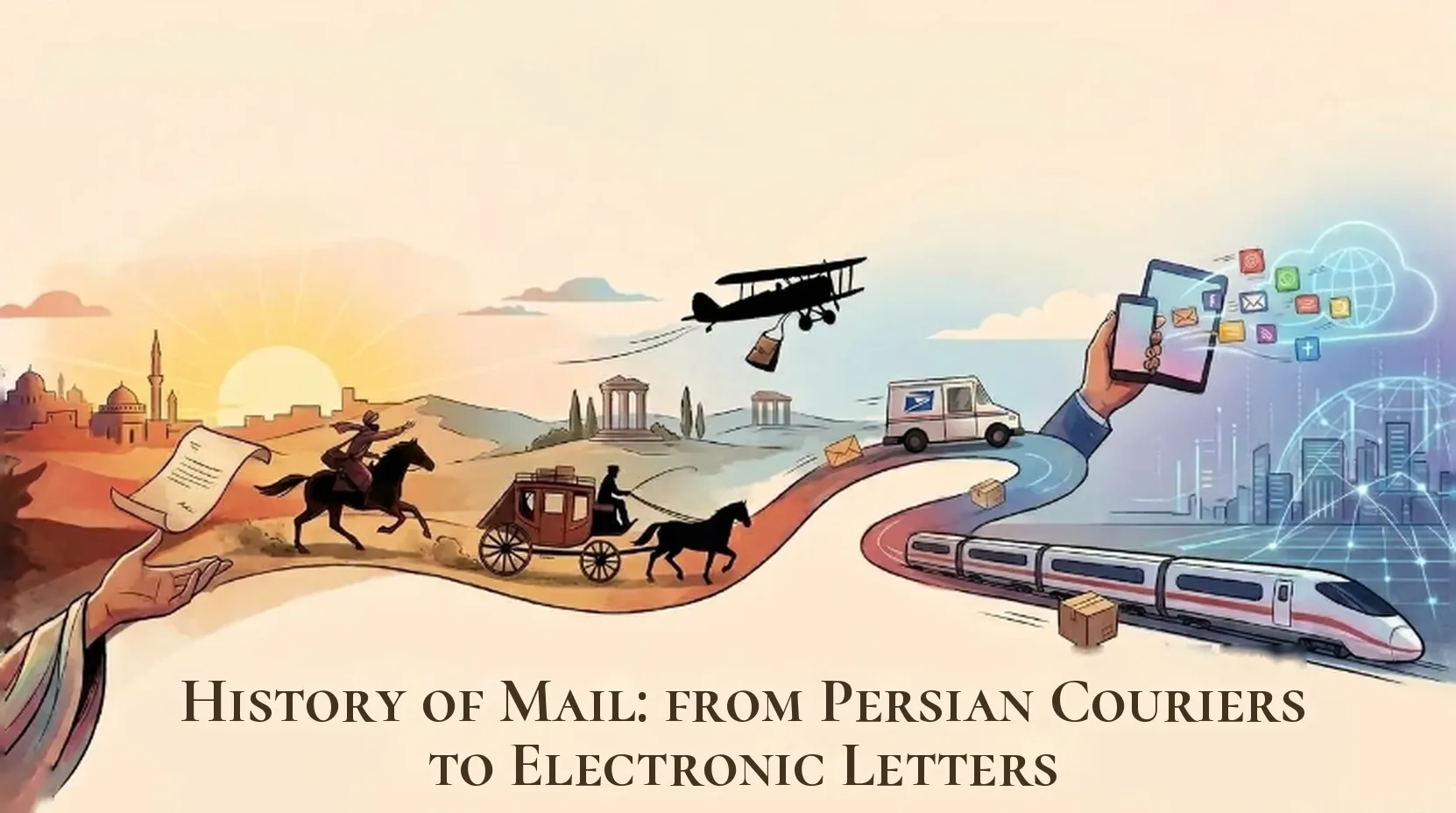
The post is humanity's oldest communication "network". Thousands of years before the internet, people were already looking for ways to send messages over long distances quickly and reliably. At first, only rulers had this privilege: they used couriers to send decrees, military dispatches and tax reports from one region to another. Over time, the post opened up to merchants, ordinary families and, eventually, to everyone. Below we follow the long road of the history of the postal service, from Persian couriers to today's parcels and emails. The ancient world: a post for rulers The first organised postal systems appeared as state services. Ancient Egypt and Mesopotamia had couriers too, but the best-known example is the Achaemenid Empire (ancient Persia). · Persian couriers. Under Cyrus II and Darius I, relay stations were built along the Royal Road, which ran from Susa to Sardis. Messages travelled relay-style: each courier covered his own stretch and handed the message to a rested rider with a fresh horse at the next station. In this way a message covered about 2,700 km in 7–9 days, while a traveller on foot needed almost 90 days for the same journey. Map of the Achaemenid Royal Road (Susa – Sardis) · The Roman cursus publicus. Under Emperor Augustus, the Romans also created a state postal service. Along the roads there were stations for changing horses and resting, but only officials were allowed to use it. · The barid of the Islamic Caliphate. Under the Umayyads and Abbasids, the state courier service acted as both a post and an internal intelligence service. In Arabic, the post is still called "barid" today. Fun fact: a 2,500-year-old "motto". Writing about the Persian couriers, the Greek historian Herodotus said that neither snow, nor rain, nor heat, nor gloom of night could stop them. These words are carved on the facade of New York's General Post Office (now the James A. Farley Building), opened in 1914, and many people think they are the official motto of the US Postal Service. In fact, the USPS has no official motto. The inscription on the James A. Farley Building in New York A post without horses: the Inca chasqui The Inca Empire in South America had neither horses nor wheeled transport, yet the Incas built one of the fastest messenger systems in the world. It was based on relay runners called "chasqui". · Along the Inca roads, roughly every 2.5 km, stood "chasquiwasi", or chasqui houses. A chasqui ran his stretch and passed the message on to the next, rested runner. · Messages were delivered orally or as a "quipu", a record made of knotted cords. · This relay could carry a message up to 300 km in a single day. Fun fact: according to Spanish chroniclers, chasquis even brought fresh fish from the ocean coast to the mountain capital of Cusco for the emperor's table. The modern era: the post opens to everyone Between the 15th and 19th centuries, the post gradually changed from a service for rulers into a public one. The most important turning points were the prepaid stamp and an international agreement. 1490 | The Taxis family set up a regular mounted postal service in the Holy Roman Empire. 1516 | In England, Henry VIII created the office of "Master of the Posts"; Royal Mail dates its history from this year. 1714 | As part of Peter the Great's reforms, the first post office opened in Saint Petersburg. 1840 | Britain issued the world's first adhesive postage stamp, the Penny Black. 1874 | In Bern, 22 countries founded the General Postal Union (renamed the Universal Postal Union, UPU, in 1878). 9 October, the day the treaty was signed, is now celebrated as World Post Day. The Penny Black, the world's first adhesive postage stamp (Great Britain, 1840) Why was the stamp a revolution? Before 1840, the recipient paid for a letter in Britain, and the price depended on the distance and the number of sheets. The recipient could even refuse to accept the letter. Rowland Hill proposed a flat rate of one penny for a letter of up to half an ounce (about 14 g), regardless of distance, paid in advance. As a result, the number of letters rose from about 76 million in 1839 to 169 million in 1840. Fun fact: on 10 January 1840, free postage privileges were abolished. Even Queen Victoria gave up her own privilege to set an example for others. Paris under siege: balloon mail and pigeon post On 19 September 1870, Prussian troops laid siege to Paris, and until 28 January 1871, more than four months, the city was cut off from the outside world. Parisians began sending letters out by balloon. · During the siege, 67 balloons carried more than 160 people, about 380 pigeons and some 2.5 million letters out of the city. · Pigeons carried the replies back into the city. René Dagron put the messages on microfilm: a light tube tied to a pigeon's tail feather could hold thousands of short messages. In Paris, the films were projected onto a screen with a "magic lantern", and clerks copied them onto paper. · People also tried floating letters down the Seine inside zinc spheres ("boules de Moulins"), but none of them reached their destination during the siege. Some were found decades later, the most recent in 1988. Zinc spheres known as "boules de Moulins" The 20th and 21st centuries: from children to rockets Children sent by mail. On 1 January 1913, the US launched its Parcel Post service. At first, packages of up to 11 pounds (about 5 kg) could be sent, and from early 1914 up to 50 pounds (almost 23 kg). Soon, some parents began mailing their children too. The first known case was recorded in January 1913 in Ohio: a baby boy was mailed to his grandmother about a mile (1.6 km) away for 15 cents. The most famous "parcel" was five-year-old Charlotte May Pierstorff. On 19 February 1914, in Idaho, she was sent to her grandmother on a mail train with 53 cents' worth of stamps stuck to her coat, because this was much cheaper than a train ticket. She rode in the mail car with a postal clerk. After such cases, sending people by mail was officially banned in 1914, although a few cases occurred until 1915. Rocket mail. On 8 June 1959, the US Navy launched a Regulus I cruise missile from the submarine USS Barbero. Instead of a nuclear warhead, the missile carried about 3,000 letters. It reached Naval Station Mayport in Florida in 22 minutes. However, this kind of delivery was too expensive and complicated, and the experiment was never repeated. Launch of the Regulus I missile from the submarine USS Barbero Key dates in history: · 1911: the first official airmail flight took place in India (Allahabad). · 1941: postal codes were introduced in Germany, and in 1963 in the USA. · 1971: Ray Tomlinson sent the first email and used the "@" sign in the address. · Today: there are fewer traditional letters, but online shopping has sharply increased the flow of parcels. After independence, private courier and express delivery companies such as EMU Express also appeared in Uzbekistan. They offer office-to-office and door-to-door delivery, online tracking and fulfilment services for e-commerce. Conclusion From Persian couriers to the Penny Black, from Inca runners to rocket mail, the purpose of the post has never changed: to connect people, whatever the distance. Every letter delivered today is the result of thousands of years of experience.